How Le Corsaire Builds Its Imaginary: Veils, Jewels, Drapery and Adventure…
Le Corsaire is a Romantic-era ballet whose visual identity often reads as a compact catalogue of Orientalist signifiers: harems, bazaars, sultans and odalisques. This analysis looks beyond pretty ornament to show how veils, jewellery, draped fabrics and a jewel-bright palette work together so that costume carries narrative weight, codifies role hierarchies and fashions memorable stage images.
Quick answer
Le Corsaire’s visual world consistently mixes Romantic ballet dress with explicitly Orientalist motifs — tulle skirts, veils, turbans, draped brocades and heavy jewellery — so that costume both locates scenes (bazaar, harem, palace) and shapes how the audience reads bodies and movement.
What this article explains
- How the ballet announces its world before a single gesture through Orientalist cues combined with Romantic silhouettes.
- Why veils, jewellery and drapery function as narrative markers and status signals on stage.
- How colour, texture and layered costume interact with choreography to produce recognisable, lasting images.
THE FIRST VISUAL WORLD OF THE BALLET
From the first set and costume reveal, Le Corsaire tends to present a dual vocabulary: the formal language of Romantic ballet (clear tutu lines and classical port de bras) layered with a vocabulary of Orientalist spectacle (harem and bazaar signifiers). This duality is not decorative alone. It immediately frames the story world as both familiar to ballet audiences and explicitly exotic; the expectation is a hybrid viewing code where classical technique is performed inside a stylised foreignness.
COSTUME SILHOUETTES AND CHARACTER LANGUAGE
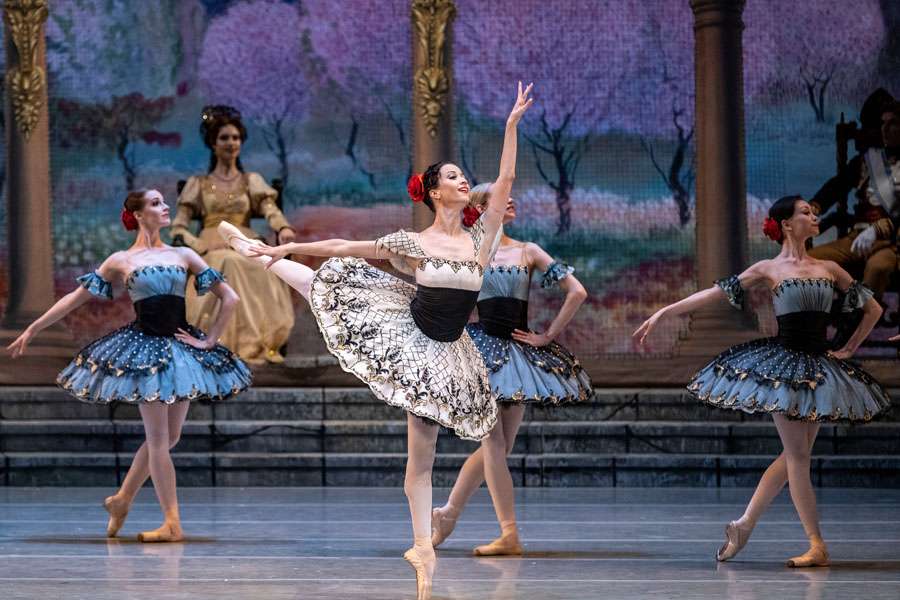
Silhouette is one of the first signals of theatrical function in Le Corsaire. Program notes and company descriptions consistently note the interplay between Romantic dress and exotic garments. A ballerina’s tulle skirt remains a shorthand for classical virtuosity and purity of line; when that tutu is paired with veils or draped panels, the costume reassigns those same classical attributes to a different dramatic identity — an odalisque, a captive, a celebrated exotic beauty. On the male side, turbans, brocades and layered drapery introduce a different set of proportions: broader, more horizontal massing at the shoulders and torso that contrasts with the vertical line of the ballerina and therefore establishes a visual hierarchy without words.
COLOUR, TEXTURE, AND ATMOSPHERE
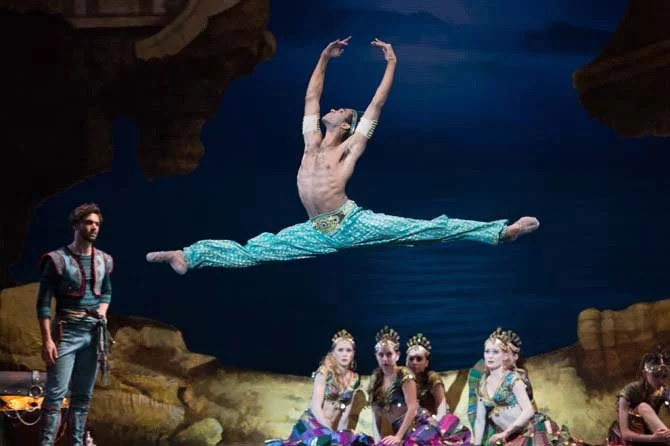
Contemporary production commentary and reviews frequently describe Le Corsaire costumes as "jewel-bright". That jewel-quality is not mere gloss; bright, saturated colours and rich brocades act as narrative shorthand. In a crowded harem or bazaar scene, a concentrated palette of gems and metallics makes key figures read at a distance — leaders, favourites and dramatic pivots keep visual priority through contrast. Texture matters as well: the cinematic sheen of brocade and metallic thread signals opulence and otherness, while the diaphanous veil reads as mobility and secrecy. Together these materials shape what the audience perceives at once — abundance, danger and eroticised luxury — without needing additional stage business.
COSTUME AND MOVEMENT TOGETHER
Designers and company study guides for Le Corsaire highlight a deliberate collaboration between costume and scenery to stage specific narrative moments. Veils and draped fabrics do more than decorate: they extend and annotate movement. A veil can lengthen an arabesque line visually, turning the trailing fabric into an extension of the limb and thereby amplifying a pose. Conversely, heavy jewellery and layered brocade concentrate visual weight on the torso, which can make upper-body stillness read as a ceremonial or ritual presence while allowing legs to execute rapid footwork beneath. The interplay of diaphanous and structured pieces therefore creates contrasting motion registers on stage that help differentiate solo virtuosity from ensemble spectacle.
ICONIC IMAGES, SCENES, AND MEMORY
Le Corsaire’s most durable images are distilled combinations of prop and costume: a veiled figure in a shaft of stage light, a jeweled favorite at the centre of a swirling harem, or the flash of metallic fabric across a group formation. These condensed pictures persist because they compress plot and mood into a single readable tableau. Critics and designers note how costumes often steal the eye in reviews not as mere ornament but as the element that makes a moment cinematic and memorable. That cinematic quality — jewel-bright colour, layered drapery and precise silhouette — is what audiences often recall long after the music and steps are forgotten.
DIFFERENT PRODUCTIONS, DIFFERENT VISUAL READINGS
Across companies and revivals,what remains recognisable in Le Corsaire is the orientalist vocabulary itself: veils, turbans, brocades, jewellery and the fusion of Romantic tutu with exotic accoutrement. Designers vary how literal or stylised those motifs are. Some modern stagings emphasise cinematic textures and saturated colour to foreground spectacle; others choose a calmer palette or simplified drapery to shift emphasis onto choreography or narrative plausibility. Regardless of approach, productions rely on the same toolkit because those elements carry specific meaning: they mark scene type, announce status, and create contrast between human bodies and the set’s imagined exotic world.
VISUAL MEMORY AND CULTURAL AFTERLIFE
Le Corsaire’s visual afterlife is less a single costume image than a cluster of repeated signs: the veiled odalisque, the jeweled favourite, the brocaded sultan. These motifs become cultural shorthand for the ballet’s adventure-and-exoticism premise. Program and study guide commentary from established companies underline that visual design and scenic choices intentionally cultivate this shorthand so that even a single costume element can recall the larger narrative context for the audience. The persistence of these signs explains why Le Corsaire continues to be presented with an orientalist aesthetic: it is the most direct visual language the work has relied upon to communicate its scene types and dramatic contrasts.
CLOSING INTERPRETATION
Le Corsaire demonstrates how costuming can be both decorative and narratively operative. Veils, jewels, drapery and a jewel-bright palette do more than create an exotic mood: they delineate role, manipulate perceived bodyline, and stage a register of motion that becomes part of the choreography’s grammar. Companies and designers may alter details, but the ballet’s visual identity persists because its costume vocabulary reliably structures how audiences understand status, desire and spectacle on stage.
Author: Eric M.