Notre-Dame de Paris on Stage: From Perrot’s La Esmeralda to Roland Petit’s…
Notre-Dame de Paris has never been a single fixed ballet but a question posed to dance-makers across more than a century: how to translate Victor Hugo’s dense novel into movement, spectacle and theatrical identity. Two choreographic lives anchor that history—Jules Perrot’s mid‑19th-century La Esmeralda, whose pas de deux survives in concert repertory, and Roland Petit’s full-length Notre-Dame de Paris for the Paris Opera in 1965. Each adaptation shows a different tactic for turning prose into stage action, and together they reveal how staging choices and star performers decide a dance work’s destiny.
Quick answer
Perrot’s La Esmeralda (1844) distilled Hugo into 19th‑century ballet spectacle and left a durable concert fragment; Roland Petit’s 1965 Notre-Dame de Paris reimagined the novel as a dramatic, full‑length opera‑house ballet with a modern creative team and institutional afterlife at the Paris Opera.
What this article explains
- The different creative strategies used by Jules Perrot and Roland Petit to adapt Hugo’s novel.
- Which musical and staging choices shaped each adaptation’s reception and survival.
- How performers and company traditions fixed key images and repertory fragments into the ballet canon.
How the ballet began
The story of Notre-Dame de Paris in dance begins with Jules Perrot’s La Esmeralda, premiered in London on 9 March 1844 with music by Cesare Pugni and Carlotta Grisi in the title role. Perrot’s project was typical of Romantic‑era ballet: select striking episodes from a popular novel, reshape them into a sequence of divertissements, solos and pas de deux, and foreground virtuosic display around a lead ballerina.
More than a century later, Roland Petit approached the same source with a different institutional scale and aesthetic. His full‑length Notre-Dame de Paris premiered at the Paris Opera (Palais Garnier) on 11 December 1965 with a new score by Maurice Jarre, sets by René Allio and costumes by Yves Saint Laurent. Petit moved beyond episodic divertissement toward sustained dramatic continuity across two acts and thirteen tableaux, aiming to make Hugo’s psychological and social tensions legible in modern ballet form.
The artists behind the adaptations
Perrot and Pugni represent the mid‑19th‑century partnership of choreographer and composer that produced ballets built for star dancers and touring circuits. Perrot’s La Esmeralda is thus a product of Romantic balletic syntax—story fragments knitted together by music that emphasizes danceable set‑pieces.
By contrast, Roland Petit’s 1965 team—composer Maurice Jarre, set designer René Allio and Yves Saint Laurent as costume designer—signalled a modern, collaborative approach in which music, scenography and couture informed a unified dramatic world. The original cast at the Paris Opera (Claire Motte as Esmeralda; Petit performing Quasimodo; Cyril Atanassoff as Frollo; Jean‑Pierre Bonnefous as Phoebus) anchored the work in the company’s repertory life from the outset.
Music, score identity and performance tradition
Perrot’s La Esmeralda used Cesare Pugni’s music, a score serving the nineteenth‑century impulse for clear, danceable rhythms and melodic gestures suited to solos and pas de deux. Although the full-length La Esmeralda has become less common outside Russia, musical numbers—especially the Esmeralda pas de deux—have persisted in concert repertoire because they encapsulate the era’s stylistic virtues.
Roland Petit’s Notre-Dame de Paris presented a commissioned score by Maurice Jarre, composed explicitly for a modern theatrical narrative. Jarre’s music, tied to a two‑act, thirteen‑tableau structure, aimed to sustain drama rather than merely accompany showpieces. The production’s presence in the Paris Opera’s repertory and streaming offerings confirms the score’s integration into an institutional performance tradition.
The dramatic core: story, staging and visual strategy
Perrot’s adaptation concentrated on episodes that allowed spectacular solos and romantic tableaux—emptied of much of Hugo’s dense social commentary but effective at creating memorable dance moments. Its dramatic identity is consequently fragmentary and centered on the ballerina’s virtuosity.
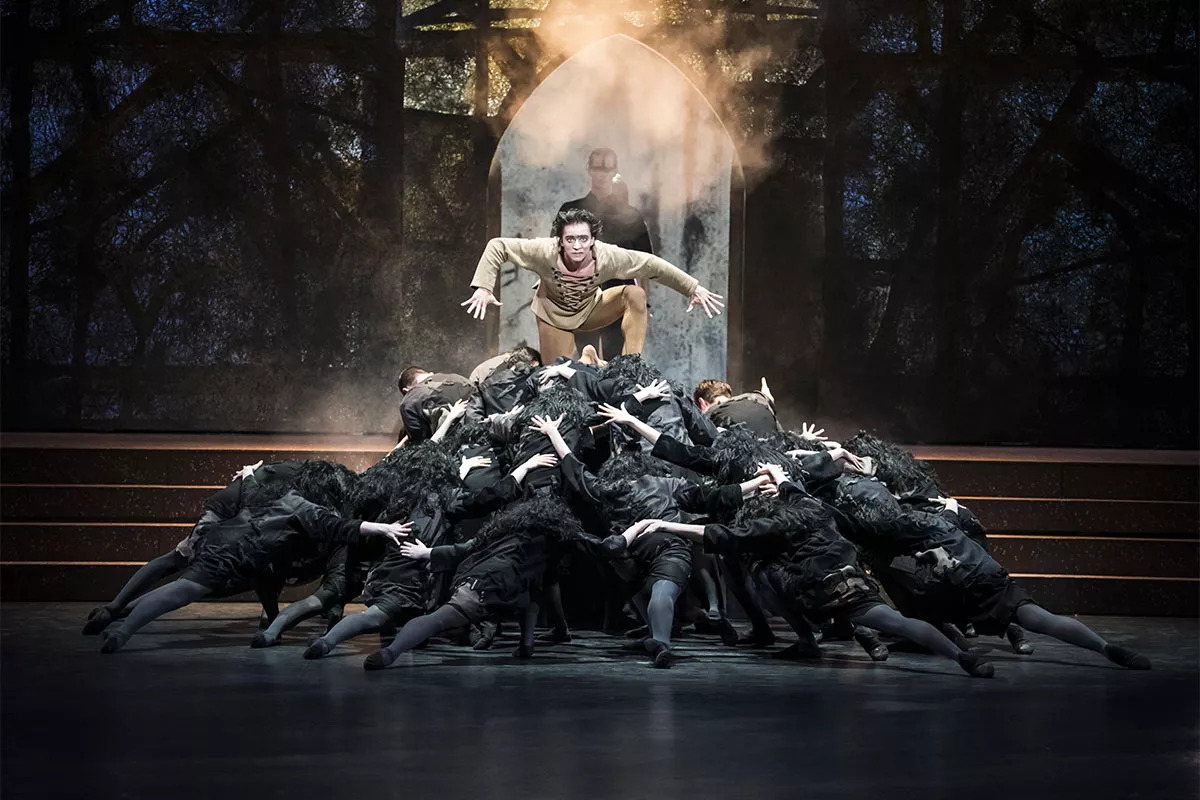
Petit’s Notre-Dame de Paris consciously pursued a fuller dramatization. Organizing the ballet into multiple tableaux, Petit and his designers created a visual and narrative continuity intended to translate Hugo’s complex emotional stakes into staged scenes. Yves Saint Laurent’s costumes and Allio’s sets contributed to a recognisable visual world that helped the production speak to audiences as an operatic ballet rather than a sequence of divertissements.
Great interpreters and the making of repertory memory
Signature performers always determine how an adaptation is remembered. Carlotta Grisi’s original Esmeralda for Perrot established the role’s early iconography; over time, the Esmeralda pas de deux detached from the larger ballet and entered concert programmes, where generations of ballerinas have used it to showcase technical and theatrical gifts.
For Petit’s 1965 creation, the original Paris Opera cast—notably Claire Motte as Esmeralda and Petit himself as Quasimodo—helped fix the ballet’s dramatic contours and secured its institutional longevity. That visibility within the Paris Opera repertory, and the company’s archival and streaming presence, has kept Petit’s conception alive for new audiences and dancers.
Revivals, revisions and repertory life
La Esmeralda followed a typical 19th‑century afterlife: Marius Petipa fashioned an important revival for the Imperial Ballet in Saint Petersburg in 1886, anchoring the work in the Russian repertory tradition. Yet, outside Russia the full ballet is less frequently staged; its survival largely rests on extracted numbers that travel independently.
Petit’s Notre-Dame de Paris, by being created for the Paris Opera with a major creative team, entered institutional repertory in a way that supports periodic revivals and archival circulation. The Paris Opera’s documentation and streaming of the ballet demonstrate how an institution can sustain a modern adaptation through company repertory choices and digital presentation.
How these ballets entered cultural memory
The divergent afterlives of Perrot’s and Petit’s works show two mechanisms of cultural survival. Perrot’s Esmeralda survives through its extractable, high‑visibility dance numbers; Petit’s adaptation endures through institutional endorsement and a full dramatic reworking that suits the Paris Opera’s repertory model. Scholarly attention to both versions—doctoral studies that compare Perrot and Petit—further secures their place in academic and choreographic discourse.
Why this history matters
The history of Notre-Dame de Paris as a choreographic subject reveals an essential lesson: adapting a dense novel to dance forces a choice between episodic spectacle and integrated drama. Perrot’s La Esmeralda crystallised the Romantic ballet’s strengths—virtuosity and spectacle—producing durable concert fragments. Petit’s full‑length Notre-Dame de Paris reclaims narrative weight by assembling music, design and dramatic casting into a cohesive stage world and securing institutional life at the Paris Opera.
Seen together, the two works map how different theatrical economies—19th‑century star vehicle versus 20th‑century opera‑house drama—shape which parts of Hugo’s novel survive in movement. That is why studying these ballets is not merely antiquarian: it shows how choreography, music and performers collaborate across eras to translate literary imagination into the living grammar of the theatre.
Author: Alex R.