Are ballerinas born talented or trained? The interaction behind elite dancers
Ballet sparks the familiar question: do elite ballerinas arrive with a gift, or are they made by training? The short, evidence‑based answer is: neither alone. Research supports an interactionist view—certain innate attributes shape early selection, but sustained, deliberate training and high‑quality coaching are essential to reach elite levels.
Quick answer
Both. Physical predispositions such as favourable proportions, turnout potential, flexibility and body awareness are commonly used to identify potential, while sustained, focused practice and quality pedagogy produce the technical, artistic and performance skills that create elite ballet dancers.
What this article reveals
- Which innate traits matter for early selection and why they are limited in scope.
- How deliberate, multi‑year training transforms potential into elite performance.
- What teachers and companies notice beyond a single impressive physical trait.
Defining the question: what do we mean by "born" and "trained"?
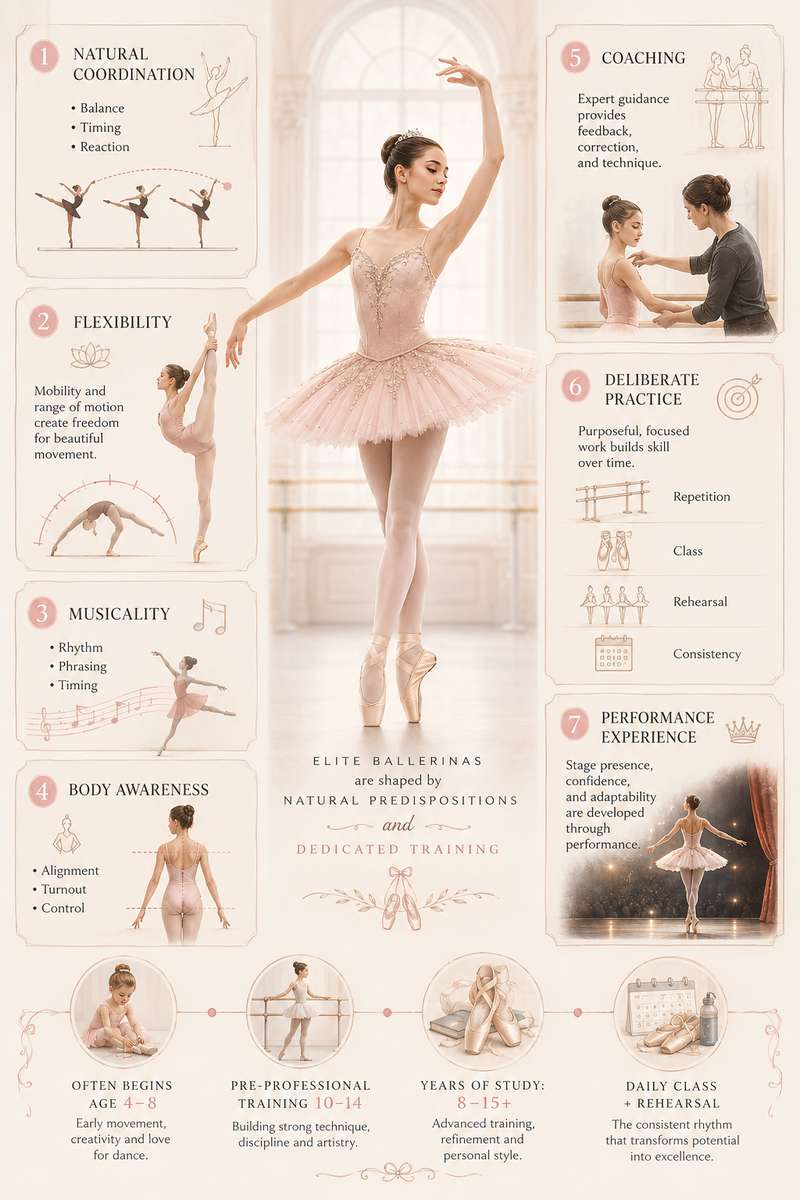
"Born talented" refers to inherited or early‑appearing traits—body proportions, basic flexibility, kinesthetic sense and motor coordination—that make learning ballet technically easier in some respects. "Trained" refers to the long, deliberate, and high‑quality practice, pedagogy and performance exposure required to convert those traits into repeatable professional technique and artistry. Verified research shows both elements matter and interact; one does not fully substitute for the other.
Which innate traits matter—and where they stop
Studies identify structural and neuromotor features commonly used in vocational selection: limb proportions, turnout potential, basic flexibility and body awareness. These traits make certain classical shapes and lines more achievable and can ease early technical learning. However, some anatomical constraints—such as natural turnout range driven by bone structure—cannot be fully altered by training. That means early identification of potential is common, but limited in what it predicts alone.
Why training is essential: deliberate practice and pedagogy
Evidence connects intensive, sustained, focused practice over years with high performance in complex domains. For ballet, that translates into progressive, multi‑year technical training, repertoire rehearsal, pointe preparation, conditioning, and consistent stage time. Quality instruction and appropriate pedagogical approaches—teacher expertise, somatic techniques that build body awareness, and structured deliberate practice—shape how quickly and safely a dancer develops, and how far they go.
How innate traits and training interact
Research supports an interactionist model: genetic and heritable factors influence motor ability and the propensity to practice, while the environment—coaching, curriculum, and performance opportunities—amplifies or constrains that potential. For example, musicality and rhythm sensitivity are trainable, but an early kinesthetic aptitude can make acquiring musical nuance quicker. Conversely, strong training can compensate for moderate physical limitations through improved alignment, strength and coordination, up to the boundary set by certain anatomical constraints.
What teachers and audition panels actually notice
Selection decisions rarely rest on one spectacular move. Panels and teachers look for a cluster: clean foundations, repeatable placement, coordination, musical responsiveness, coachability, and learning speed. Physical traits open doors at early selection points, but panels value potential to respond to training and to perform reliably. Pedagogical context matters: a dancer who adapts to correction and improves quickly is more attractive than a raw performer who cannot sustain quality under rehearsal load.
Hidden obstacles and common misconceptions
One misconception is that flexibility or a single striking line equals readiness for professional work. In practice, repeatability under fatigue, strength to support alignment, and injury‑resilient technique matter more. Another hidden obstacle is assuming training alone can change certain anatomical limits; while alignment and strength can improve artistry, bone‑structure constraints influence long‑term role suitability. Finally, genetic predispositions include motivations and practice propensity—some dancers are naturally inclined to persist with hard training, which itself becomes part of the advantage.
From studio to stage: where potential is tested
The progression from recreational classes to a vocational pathway exposes differences. In local classes the emphasis is learning steps and joy; in pre‑professional training, frequency, load and technical precision increase; in vocational schools and traineeships, teachers assess how technique withstands daily rehearsal and how performance quality translates on stage. Performance experience—stage time and repeated runs of repertoire—teaches musical phrasing, stamina and the subtle control that distinguishes corps reliability from soloist nuance.
Practical tests of potential (what reveals real promise)
Useful, non‑absolute indicators include fast and stable technical correction, consistent quality under repetition, coordinated musical phrasing, and demonstrated improvement with coaching. These are more informative than a single high extension or a viral video. Because longitudinal evidence is key, panels often prefer students who combine favourable physical traits with proven learning trajectories in demanding training settings.
What this means for students, parents and late starters
If you or your child has naturally helpful proportions or coordination, those traits can ease progress and improve selection chances for vocational paths. But success still requires years of deliberate, structured practice and expert instruction. For late starters, the interactionist view warns against simple answers: while becoming a polished dancer is possible with focused work, entering the childhood vocational pipeline that feeds many major companies is a different proposition. Goals should be framed according to level: recreational enjoyment, advanced adult training, regional professional work, or aiming for company placement—each demands different timelines and resources.
Closing interpretation: neither pure birthright nor pure construction
Verified research places ballet excellence in the space between nature and nurture. Innate physical and neuromotor traits influence early selection and can set constraints; deliberate, multi‑year practice, high‑quality pedagogy and abundant performance experience are what convert those traits into elite, repeatable artistry. The most reliable pathway combines honest appraisal of natural advantages with disciplined, well‑guided training that emphasises bodily control, musicality, injury prevention and stage experience.
Author: Alex R.