Is it too late to become a professional ballerina?
Short answer: it depends on what you mean by "professional ballerina." If you mean entering the elite, childhood-to-vocational pipeline that supplies most major classical companies, starting late makes that route far more difficult. If you mean building a serious, rewarding career in dance—possibly in contemporary, regional, or alternative company roles, or related professions—the path is different but often possible with focused, intelligent training.
The tension here is real: most classical companies still rely on dancers who began intense, syllabus-based training in early childhood, yet there are documented exceptions and alternative pathways that mature starters can pursue.
The honest answer
Most major classical companies expect the long, early training that begins in childhood; starting later reduces the likelihood of following that specific pathway. However, some dancers have begun seriously in their early-to-mid teens and reached professional careers—these are exceptions, not the norm. Adult beginners can still develop dance-specific strength, musicality, and technique, but the timeline and realistic goals must change.
What this article reveals
- Why early childhood training remains the dominant route into major classical companies.
- Which physical and technical attributes are easier to build earlier—and which can be trained later.
- Realistic pathways for late starters, including company types and adjacent careers.
What major companies really expect
Verified sources show that most professional classical ballet dancers begin formal training very young—commonly between ages 3–8—and progress into pre-professional tracks during early adolescence. This extended, syllabus-based training remains the norm for the repertoire, stamina, and stylistic demands of top-tier classical companies.
That early investment builds layered, dance-specific motor patterns, consistent technical habits, and the rehearsal tolerance needed for intensive company life. Because this is the standard route, auditions and company selections are often calibrated against dancers who have spent many years in structured training systems.
What starting late actually means
“Starting late” covers a range of situations: beginning recreational classes as a teenager, switching disciplines in early teens, or taking up ballet seriously as an adult. Verified reporting notes that some successful professionals began serious training in early-to-mid teens rather than in toddlerhood—but these cases are exceptions.
For adult beginners, the challenges include compressing years of technical learning into a shorter timeframe and adapting joints, tendons, and neuromuscular patterns that are easier to shape during adolescence. Dance science shows these attributes are trainable later in life, but the time and structured conditioning required are substantial.
Technique, physical capacity, and age
Physiological factors—flexibility, joint mobility, tendon stiffness, and the development of dance-specific neuromuscular patterns—are generally easier to establish earlier in adolescence. That said, research and expert commentary confirm that adult trainees can improve strength, endurance, and motor control significantly with progressive training and careful conditioning.
The practical consequence: a later starter can make large gains, but reaching the technical fluency and repeatable performance quality expected in a corps de ballet or higher may require many years of disciplined, progressively loaded training with attention to injury prevention.
Hidden obstacles and common misconceptions
Two common myths deserve correction. First, visible flexibility or a beautiful photo does not equal the repeatable technical control companies need under fatigue and in ensemble work. Second, a single impressive variation or performance clip rarely substitutes for the layered technical foundation and rehearsal resilience that auditions and casting panels assess.
Another practical barrier is access: many pre-professional programs and apprenticeships expect prior syllabus-based training (RAD, Vaganova, Cecchetti, etc.). This makes entry harder for late starters unless they find programs that explicitly accept mature students or career-changers.
Realistic late-entry pathways
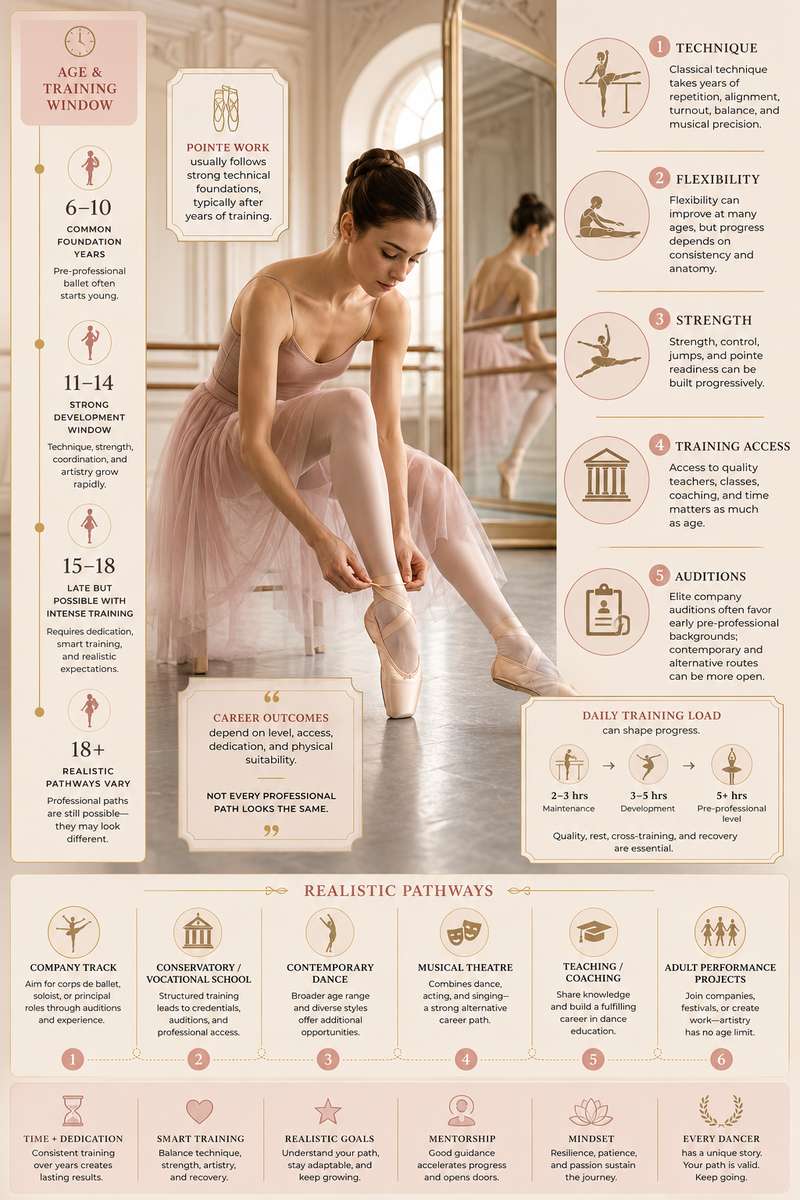
Verified sources point to several realistic directions for late starters:
- Transitioning into contemporary or commercial companies where the stylistic and physical demands differ from strictly classical repertoire.
- Pursuing roles in smaller regional companies or ensembles that may prioritise different strengths or have varied casting needs.
- Developing careers adjacent to performance—teaching, choreography, rehearsal direction, or specialized programmes for adult dancers.
- Targeting character, ensemble, or mixed-genre roles rather than aiming immediately for principal classical spots.
These pathways reflect the documented reality that while major classical companies commonly recruit from long-term training systems, other professional opportunities exist and can be reached by later starters with focused training and the right fit.
What auditions and companies notice
Audition outcomes hinge on company needs, repertoire, dancer type, and technical baseline. Companies evaluate how quickly a dancer learns, adapts, and performs consistently. Sources note that male dancers sometimes experience different late-entry dynamics due to partner-demand and shortages in some contexts, but the baseline technical expectations remain rigorous across genders.
Because companies look for ensemble reliability as well as solo capability, selectors often prioritise clean basics, musicality, strong rehearsal habits, and coachability—qualities that develop over years of structured work, not just from impressive singular moments.
Training strategy and injury management for late starters
Dance science emphasizes progressive conditioning and injury-aware programming for older starters. Building dance-specific strength, tendon resilience, and endurance must be gradual, with access to appropriate medical and conditioning guidance. Rapid overload increases injury risk; sustained, intelligently planned work produces the best results.
Practically, this means combining regular technique classes with cross-training, targeted strength work, and recovery practices—ideally under teachers and medical professionals experienced with adult dancers or career-changers.
How to test realistic potential
Useful early tests are informative without promising outcomes. Look for:
- Ability to learn and retain corrections quickly across several classes.
- Progress in alignment, turnout use, and safe strengthening of ankles and core over months—not just days.
- Durability across a full class plus a rehearsal-style run-through without drastic loss of technique.
These practical signals are better indicators of a late starter's trajectory than one impressive performance. If these signs are present and you can access focused, progressive training, more ambitious goals become realistic—though the specific target (major classical company vs. contemporary or regional work) should remain flexible.
Final interpretation
Is it too late to become a professional ballerina? For the standard route into major classical companies—yes, starting late makes that specific pathway significantly harder because those systems favour long-term childhood training. However, exceptions exist, and verified sources show meaningful professional outcomes for some who began seriously as teens. Importantly, late starters often find realistic, fulfilling careers in contemporary dance, regional companies, ensemble roles, or adjacent professions within the dance world.
The practical takeaway: define what “professional” means to you, find training and programs that accept mature students or focus on contemporary/regional work if appropriate, and commit to progressive, injury-aware conditioning. Success will look different from the childhood-to-vocational pipeline, but with honest assessment and sustained work, it can still be real and rewarding.
Author: Cynthia D.