How to get into a professional ballet school: what auditions actually look for
Auditions for professional ballet schools are not a beauty contest for the most flexible body; they are a focused assessment of current technique, musical intelligence, and clear capacity to develop further. In short: schools look at what you can do now and—crucially—how likely you are to become the dancer they need after serious training.
Below you will find a concise explanation of typical audition formats, what selection panels evaluate (technique, potential, musicality, physique, attitude), and how to prepare practically and honestly for entrance auditions.
The short version
Professional schools run structured auditions — usually a classical class and sometimes variations, pointe, partnering or video screening — and choose candidates on a mix of current classical technique, musicality, coachability and demonstrable physical potential rather than a perfectly finished performance.
What this article reveals
- Typical audition components and why each matters.
- How panels weigh current skill versus potential for development.
- Practical preparation: class work, variations, conditioning, dress, and mindset.
What happens at a professional-school audition
Leading vocational schools commonly run auditions that include a classical ballet class tailored by age group and, depending on the level, additional elements such as variations, pointe work, partnering/pas de deux, or video and preliminary screening stages. Some schools accept or require video submissions as part of initial selection.
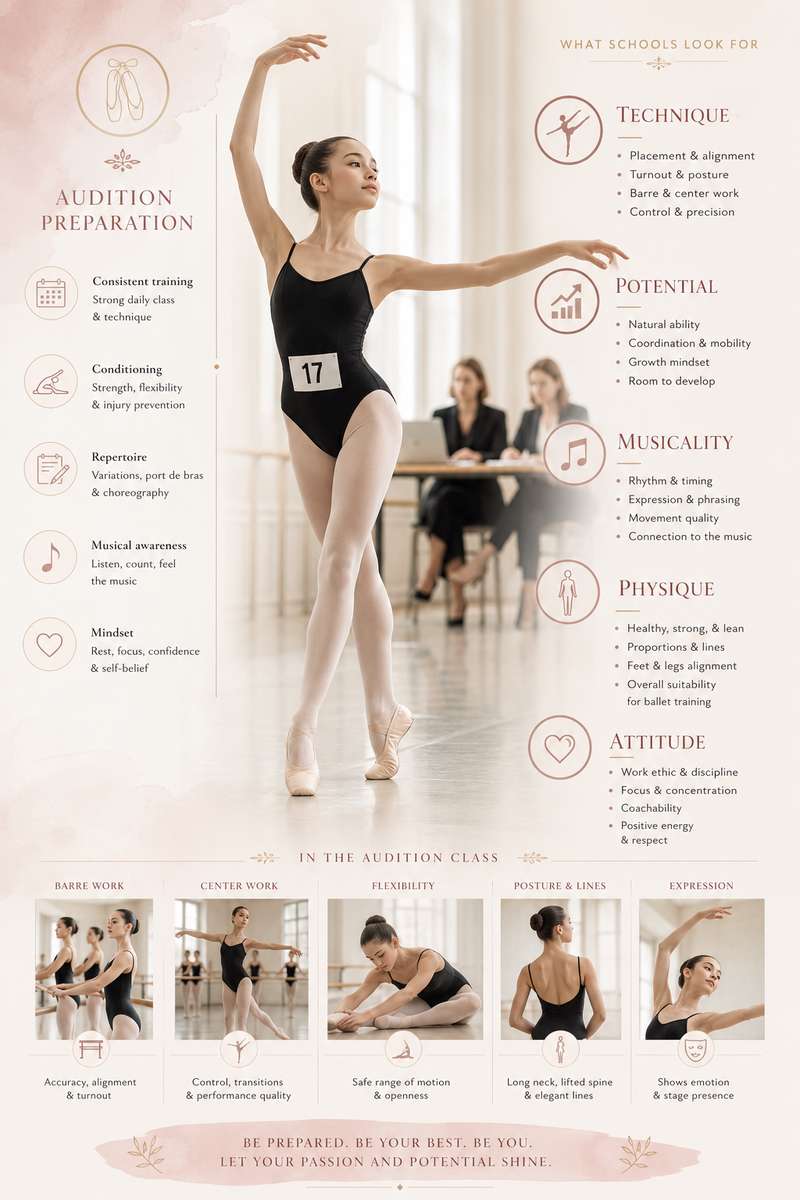
The classical class is the primary evaluation tool: teachers watch how candidates perform barre and centre exercises, observe clarity of alignment and coordination across adagio, turns and jumps, and note how dancers listen and respond to musical phrasing and correction.
What schools evaluate: the five key areas
Selection criteria across reputable institutions emphasise a combination of:
- Classical technique — quality in adagio, jumps and turns, and pointe work where applicable.
- Musicality and artistry — responsiveness to phrasing and performance intelligence.
- Physical potential — turnout, strength, proportion and a capacity to improve.
- Learning speed and coachability — how quickly a candidate corrects and integrates feedback.
- Professional attitude — discipline, preparedness, and consistency in the audition setting.
Schools state explicitly that they are looking for potential as well as present ability. The distinction matters: panels prefer a candidate who shows a clear capacity to benefit from intensive training over one who can perform a polished trick but lacks trainability.
Technique now versus potential to develop
Professional schools assess both finished technique (what you can reliably do in class) and potential (physical and learning attributes that predict growth). Classical technique is visible in clean placement during centre work — secure épaulement, controlled adagio, clean footwork in allegro, accurate turns and stable landings. But schools also watch whether a student’s body organizes efficiently under correction and fatigue.
Potential is judged by physical attributes such as natural turnout, alignment tendencies, muscle support, and proportion, and by behavioural signs: concentration, responsiveness, and the willingness to assimilate technical instruction. Documents from major schools and selection criteria emphasise that potential can outweigh a less-polished current technique when the candidate displays strong trainability.
How to prepare for an entrance audition
Guidance from major schools recommends focused technical preparation and practical readiness. Key elements include regular class work that mirrors the audition structure, rehearsed variations and music submission where required, targeted conditioning to support jumps and pointe where appropriate, and attention to professional details such as appropriate audition dress and punctuality.
Mental preparation matters: panels notice professionalism, focus, and how a candidate accepts correction. A calm, coachable presence in class signals readiness for a demanding vocational environment.
What teachers and artistic staff really notice
Beyond isolated tricks or extraordinary lines, audition panels look for reliable basics. They observe how a candidate repeats combinations, absorbs correction, and moves in ensemble class—attributes that predict how the student will cope with daily, progressive training. Musical responsiveness — not just timing but phrasing and intention — is a frequent differentiator.
Schools also use variations, pointe or partnering sessions to see specific skills in context: partnering shows spatial awareness and touch; pointe work reveals foot strength and secure alignment; a prepared variation displays musical and stylistic choices. Video auditions may be used to prescreen candidates for in-person rounds or to invite scholarship consideration from festivals and competitions.
Hidden obstacles and common audition misconceptions
Two mistakes auditionees make are treating the audition as a single performance to dazzle, and assuming extreme flexibility or a viral variation guarantees selection. Panels deliberately evaluate learning potential and ensemble suitability. A polished solo can impress, but it rarely replaces evidence of steady class technique, musical intelligence and the temperament to improve.
Another misconception is that selection is purely objective. While technical criteria are defined, artistic fit and school philosophy influence decisions. That is why schools emphasise assessing candidates’ likely progress under their training, not merely the ‘finished article’ at audition time.
How the pathway from classes to a vocational school usually unfolds
Training paths vary, but schools and professional programmes typically expect progressive exposure: regular classical classes, pre‑professional or intensive programmes, and workshops that replicate audition conditions. Competitions and summer intensives often serve as scholarship or placement routes, with school directors independently assessing entrants’ potential when awarding offers.
Schools will place different emphasis at each step—early auditions may prioritise physical potential and musicality, while later stages require stronger, repeatable technical quality and performance maturity. Video auditions or competitions can lead to direct invitations to school auditions or scholarships, depending on each institution’s process.
Practical checklist before your audition
Before you arrive, ensure you have:
- Practiced class combinations and any required variation or video material.
- Built physical conditioning that supports jumps, turns and pointe strength where relevant.
- Prepared appropriate audition dress and music per the school’s instructions.
- Mental readiness: rest, punctuality, and an attitude open to correction.
Remember that selection is about the match between a candidate and the school’s training environment: schools choose dancers they believe will benefit most from their curriculum, not just those who perform best on a single day.
Closing — how to read an outcome
If you succeed, an offer signals that the school judges you both technically able and likely to develop under their training. If you do not, view the audition as information: panels have assessed specific technical and developmental criteria. Work from that feedback—improve class consistency, musical responsiveness and coachability—and use intensives, targeted coaching or competitions as next steps toward a future audition.
Author: Alex R.