Do You Have What It Takes to Become a Professional Ballerina?
Ask a studio teacher, an audition panel, or a vocational school and you get a sharper question than the dream: do you have what it takes to become a professional ballerina? The quick truth is conditional: professional selection consistently rewards repeatable classical technique, an appropriate physical profile for repertoire, musicality and artistry, plus the stamina and professional habits to survive rehearsals and performances.
Quick answer
Yes—if your training produces reliable classical technique (adagio, jumps, turns, pointe work), the physical capacities companies prize (turnout, hip mobility, elevation, coordination), and you show musicality, stage presence and professional resilience. Schools and companies evaluate these qualities through classes, auditions, video submissions and medical screening.
What this article reveals
- Which observable skills and physical qualities vocational schools and companies assess.
- How technical control and repeatability matter more than a single flashy step.
- How conditioning, injury prevention and professional behaviour fit into selection.
What professional ballet actually requires
Leading vocational schools and companies make practical, testable judgments. Auditions and admissions routinely evaluate classical technique—adagio, jumps, turns and pointe work—because these elements expose control, strength and musical timing. Selection also considers physical attributes that support classical repertoire: turnout, hip flexibility, elevation and coordination. These are not arbitrary preferences: they reflect the movement demands companies expect dancers to repeat night after night.
How panels and schools assess potential
Auditions use live classes, filmed video material, and multi-stage exams to check consistent performance. A single impressive variation or viral clip is rarely decisive; panels watch how you move in class, whether you learn corrections, and whether your technique holds under the pressure of adagio, complicated turns and repeated allegro. Many vocational programs add medical screening to ensure a candidate’s body can withstand intensive training.
Technique, control and movement quality
Technique in a professional sense means more than the shape of a leg in arabesque. Panels look for placement, turnout that functions from the hip, core control that secures balances and clean footwork on petite allegro and big jumps alike. Crucially, they evaluate repeatability: can you produce the same clean line and musical phrasing after many runs? Schools such as those represented in the verified sources explicitly test adagio, jumps and turns because these sequences reveal weak technical links.
Strength, mobility and injury prevention
Dance-medicine literature and vocational programs stress that ballet is physically demanding. Strength and conditioning—targeted work for turnout support, ankle and foot strength for safe pointe work, and general endurance—reduce injury risk and sustain performance. Companies and schools are increasingly attentive to evidence-based conditioning and screening. Showing that you train carefully to build usable strength will make you a stronger candidate than relying on passive flexibility alone.
Musicality, artistry and stage presence
Technical skill must communicate. Vocational curricula and company assessments explicitly include musicality and artistry alongside technical checks. Panels notice timing, phrasing, épaulement and how a dancer shapes a line to the music. Stage presence—how you respond to an artistic direction or alter colour in phrasing—separates students who are technically capable from those who read for casting.
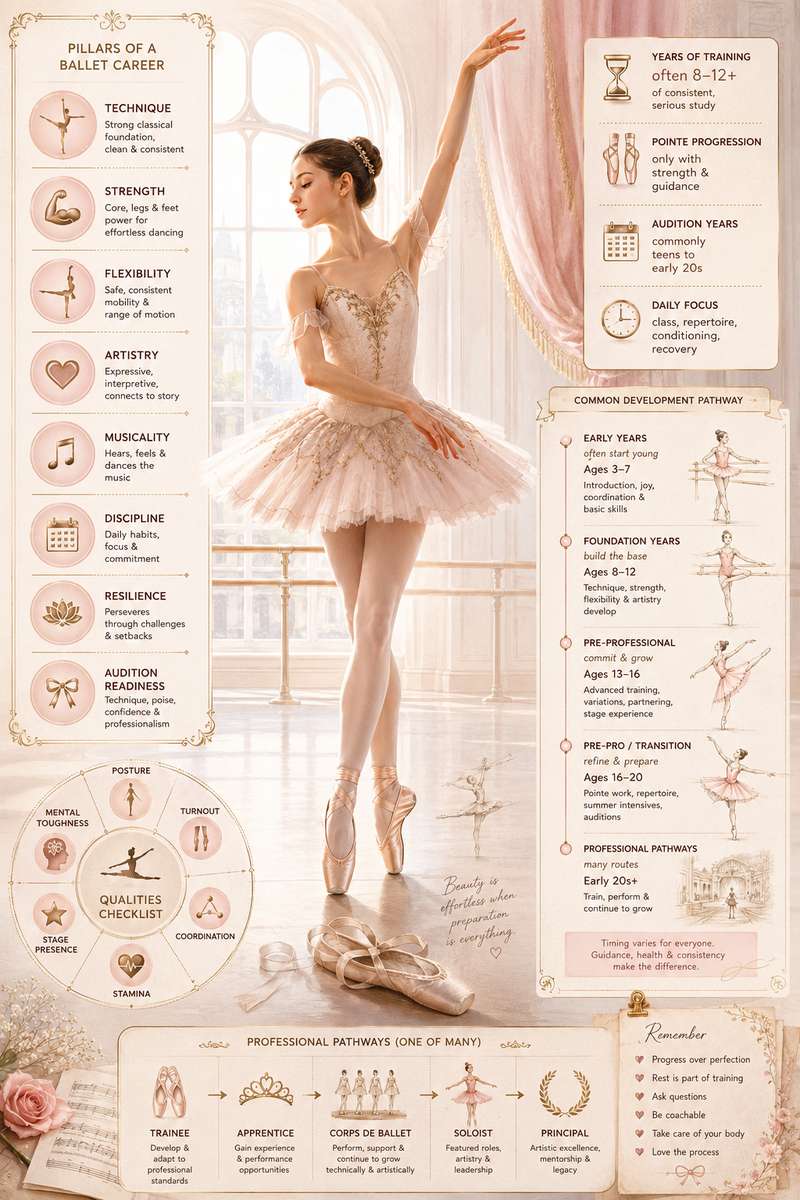
The development pathway and realistic levels
There is no single pathway to a professional career. Some dancers progress through vocational schools and conservatoires; others enter companies after pre-professional programs or positive audition showings. The important distinction is between levels: recreational classes, serious weekly training, pre-professional programs, vocational conservatoires, trainee/apprentice placements and company contracts. Each stage raises expectations: companies and vocational schools expect candidates to already possess secure classical technique and the physical traits needed for repertoire at the time of assessment.
Hidden obstacles and common misconceptions
Two misconceptions surface frequently. First, that flexibility or a single spectacular step equals professional readiness. In reality, selection panels prioritise coordinated control and repeatable technique. Second, that a single school or competition result guarantees a career. Selection is holistic: physical suitability, learning speed, coachability and artistic fit matter as much as one-off achievements.
How to test your readiness in the studio and for auditions
Practical markers used by schools and companies include:
- Consistent performance in class across adagio, petit and grand allegro, and complex turn sequences.
- The ability to take corrections and improve quickly during class.
- Durability across multiple runs or rehearsals without loss of placement or musical accuracy.
These behaviours are exactly what auditions, video submissions and entrance exams reveal, which is why major schools supply clear guidelines for filmed auditions and live exam formats.
Conditioning, professional habits and the non-technical side
Vocational programs emphasise more than steps: conditioning work, nutrition awareness, recovery strategies, and professional behaviour all support a sustainable career. Medical checks and injury-prevention strategies are standard in reputable programs because selection panels must believe a candidate can handle increased workload without frequent time-loss injuries. Demonstrating an understanding of these supports signals seriousness to selection committees.
Final interpretation and realistic next steps
If you ask do you have what it takes to become a professional ballerina, use a pragmatic checklist: can you produce secure classical technique across the elements panels test; do you possess or can you build the physical attributes companies rely on; do you respond quickly to correction; and do you invest in conditioning and recovery? If yes on most counts, pursue auditions, pre-professional programs and vocational advice; if gaps remain, target training to those specific areas rather than doubling down on appearance-only goals.
Author: Cynthia D.