How Pacific Northwest Ballet Shapes an Identity of Musical Rigor, Neoclassical…
Pacific Northwest Ballet (PNB) is a company whose public identity rests on a clear tripod: rigorous musical standards, a strong inheritance of Balanchine-era neoclassicism, and an outward-looking but locally rooted relationship with the Pacific Northwest community. This piece explains what kind of company PNB is, how those three axes were assembled into a coherent artistic profile, and why the combination still matters on stage and in the city it serves.
What defines the company
PNB is defined by a sustained commitment to musical precision—supported by its own orchestra and music director—combined with a repertory rooted in Balanchine neoclassicism and a steady program of contemporary commissions, all framed by active education and community ties in the Pacific Northwest.
What this article explains
- How a Balanchine-rooted repertory and live orchestral practice anchor PNB’s technique and stage culture.
- How artistic leadership has broadened repertory while keeping musical rigor central.
- How regional engagement shapes programming and community work without diluting artistic standards.
FIRST READING OF THE COMPANY
At first glance PNB presents itself as a regional company with national ambitions: the name suggests place, but the repertory and musical infrastructure point to something more exacting. Reviews and reporting have consistently highlighted two immediately legible features—musical precision and Balanchine/neoclassical technique—so that audiences often encounter PNB as both a practitioner of neoclassical repertory and an ensemble that insists on music as a performance partner.
HOW THE INSTITUTION TOOK SHAPE
The company’s identity is not an accident of geography. Over time PNB acquired a reputation for programming Balanchine works as a central part of its repertory; that repertorial choice has been repeatedly remarked upon in coverage and season materials. Simultaneously, the company invested in musical infrastructure by maintaining its own orchestra and appointing a dedicated music director—moves that institutionalize an expectation of live, disciplined musical collaboration and set PNB apart from many regional companies that rely on recorded tracks or ad hoc orchestral arrangements.
STYLE, SCHOOL, AND ARTISTIC TEMPERAMENT
PNB’s stylistic profile leans decisively toward neoclassicism. The Balanchine lineage visible in programming produces a stage temperament marked by clarity of line, agility, and an emphasis on musical phrasing. That temperament is reinforced, materially, by the presence of an in-house orchestra and an active music director: musical cues, tempos and phrasing are not afterthoughts but primary organizing elements for dancers and choreographers alike. This creates a performance culture in which dancers are rehearsed to respond to live musical nuance rather than fixed mechanical timing.
REPERTOIRE AND STAGE CULTURE
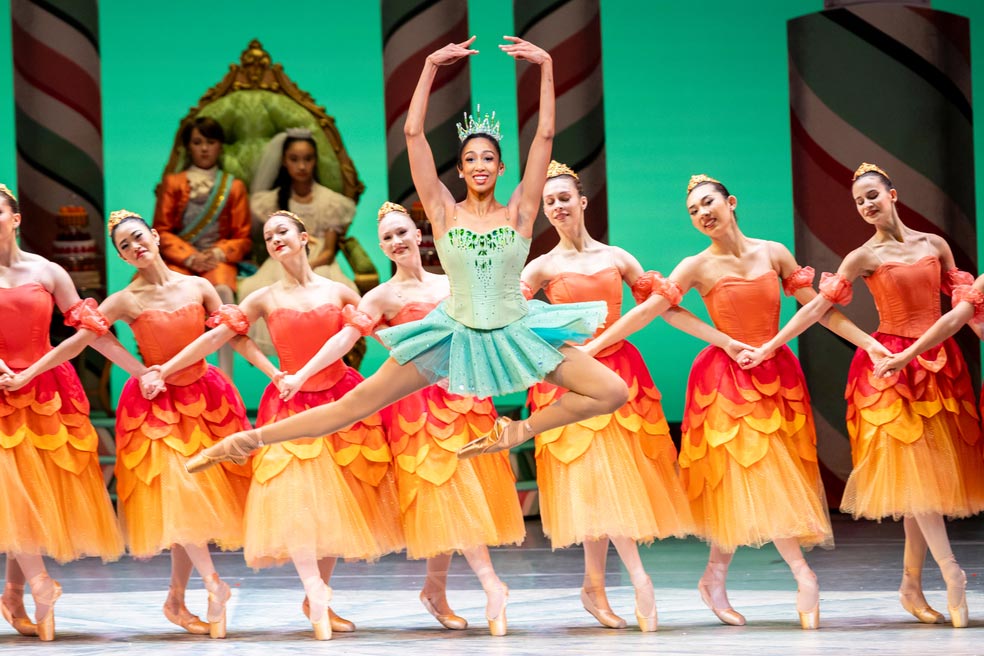
While Balanchine and neoclassical works form a visible backbone, PNB’s repertory has also widened to include contemporary choreographers and new commissions. Under recent artistic leadership the company programs a mix that pairs canonical neoclassical pieces with contemporary work, commissioning and presenting creations by important modern choreographers. This programming logic positions PNB as a company that preserves and embodies a specific neoclassical technique while testing its limits through new voices.
ARTISTS, LEADERSHIP, AND MUSICAL DIRECTION
Artistic leadership has been decisive in shaping the balance between preservation and renewal. The company’s Artistic Director has broadened repertory to include contemporary and neoclassical works alongside full-length classics and has prioritized commissioning notable contemporary choreographers. Equally central is the role of the Music Director and Principal Conductor, who has held the full-time music director role since the 2011–2012 season. That appointment—and the company’s continued investment in its orchestra—gives PNB an institutional engine for musical standards that informs casting, rehearsal practice, and performance pacing.
WHY THE COMPANY FEELS DISTINCT
PNB’s distinctiveness comes from the conjunction of three commitments that reinforce one another. First, Balanchine-rooted neoclassicism supplies a technical and aesthetic framework that privileges musical articulation and a particular approach to line and movement. Second, the in-house orchestra and stable music leadership make musical rigor an operational reality rather than an aspirational value. Third, programming that pairs this repertory with contemporary commissions prevents the company from becoming purely archival: it tests the neoclassical vocabulary against contemporary choreographic demands. The result is neither imitation nor pure innovation but a recognizable institutional temperament where music, technique, and repertory continually converse.
CULTURAL POSITION AND ENDURING MEANING
Within the larger ballet ecology, PNB functions as a model for how a regional company can sustain high musical standards while maintaining a strong repertorial identity. Coverage from regional and national outlets repeatedly links the company’s name to musical precision and Balanchine-informed repertory choices; more recent reporting also emphasizes the company’s effort to balance that inheritance with new choreography. Locally, the company frames programming decisions with regard to its Seattle and Pacific Northwest audiences and supports education and outreach work that ties stage practice to community engagement. Those choices anchor the company’s name in both an artistic conversation about music and neoclassicism and a civic conversation about regional cultural responsibility.
CLOSING INTERPRETATION
Pacific Northwest Ballet matters because it shows how institutional choices—repertory emphasis, orchestral investment, and programming strategy—can produce a coherent artistic identity. The company’s particular blend of musical rigor, Balanchine-rooted neoclassicism, and purposeful community engagement explains why its season bills and reviews read as a continuous argument about how ballet should sound and move. That argument keeps PNB’s name meaningful: not simply as a guarantor of particular ballets but as an organization that treats music, choreography and civic context as inseparable elements of a living repertory.
Author: Cynthia D.