Fourth Position Ballet Explained: Placement, Purpose, and Technical Demands
Fourth position in classical ballet places one foot directly in front of the other with a deliberate space between them and the toes turned outward. It is a common alignment used for preparation — especially for turns and many jumps — but it asks precise turnout, alignment and weight control, which makes it more technically demanding than it first appears.
Quick summary: Fourth position separates the feet by roughly one to one-and-a-half foot lengths, has open and closed variations, and is widely used as a preparation for pirouettes and jumping steps.
Jump or turn prep: Teachers commonly place dancers in fourth with a demi-plié to set alignment and weight before initiating an en dehors turn or a jeté.
Quick access: Definition • What the viewer sees • Technique
Clear definition
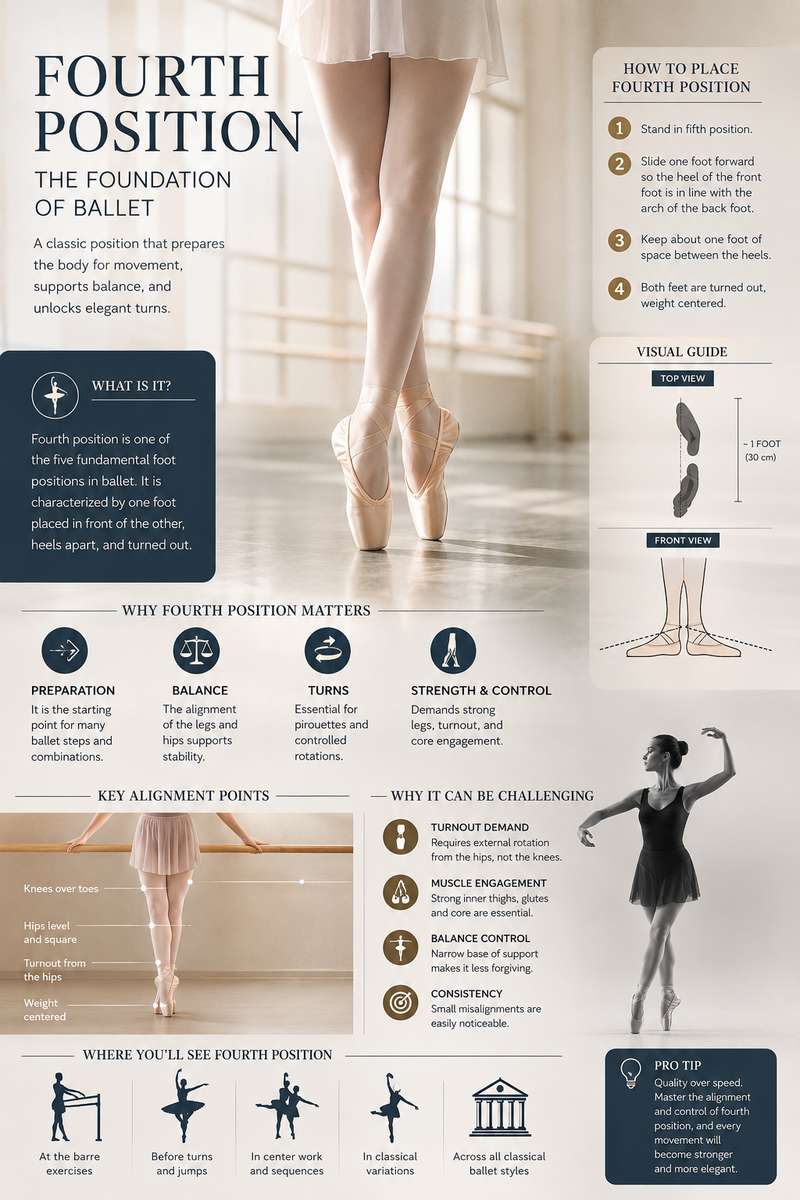
Fourth position places one foot directly in front of the other with a clear space between them. The toes of both feet are turned outward from the hips (turnout). The usual guideline for that space is roughly one foot; some authorities describe a range from one to one-and-a-half foot lengths. This spacing distinguishes fourth from the closer positions such as fifth.
What the viewer sees on stage
On stage, fourth position looks like a compact, prepared line: feet separated front-to-back, turned out, often accompanied by a low demi-plié and an engaged torso. When used as preparation the movement that follows — a pirouette, a jump or a transfer of weight — appears seamless because the fourth position has already set the dancer’s alignment and direction.
Technique and body mechanics
Proper fourth depends on turnout from the hips, even or intentionally shifted weight, and postural engagement often called "pulling up." Dancers typically use a demi-plié in fourth to store and release energy for turns and jumps. Because the feet are separated, the hips must remain square and the core active to avoid tipping forward or collapsing the supporting leg. These coordinated demands — turnout, correct spacing, precise weight placement and postural support — are why fourth can be technically challenging.
Open and closed fourth — variations and uses
Teachers and glossaries distinguish two common variations. Open fourth aligns the heels (a more parallel line visible between the feet). Closed fourth aligns the front heel with the back toe, producing a relationship similar to fifth position but with space between the feet. Both forms are used in class and on stage; the choice depends on the step, the desired line and the safe limits of a dancer’s turnout.
Training and discipline
In class, fourth is drilled as a preparatory alignment. Teachers emphasise correct distance between the feet and working within a safe turnout range. Repeating fourth in barre and centre work builds the hip strength, ankle stability and core control that fourth requires when it becomes the launching point for turns and jumps.
Stagecraft and musicality
Choreographers use fourth to clarify direction and timing. Because it naturally faces the audience or a particular diagonal, fourth helps shape entrances, exit pathways and lines that read clearly from the house. Musically, the demi-plié in fourth often coincides with a preparatory phrase — a breath or rhythmic pickup — so the physical alignment supports the musical intention before the turn or leap.
Costume, visual language and wall art
Fourth position contributes to the graphic vocabulary of ballet imagery. In photographs and posters it creates a sense of poised readiness: the layered line of two turned-out feet separated on the stage plane. That compact geometry works well in prints and wall art because it reads clearly at a distance and suggests motion about to unfold without needing full elevation or extension.
Common misunderstandings
Beginners often think fourth is simply a relaxed stance. In fact, it is an active, aligned posture that requires turnout, controlled weight distribution and core engagement. Another common error is too wide or too narrow spacing; both undermine balance and reduce the stability needed for safe turns and jumps.
Closing interpretation
Fourth position is small in appearance but central in function: it is both a preparatory tool and a visible stage shape. Understanding its spacing, open and closed variations, and technical demands clarifies why teachers emphasise it and why choreographers rely on it. Seeing fourth with this awareness makes the next turn or leap on stage feel inevitable rather than accidental, and it deepens appreciation for the precise mechanics behind the image.
Author: Cynthia D.